- Exhibition
ANGLIAN ABSTRACT
- Wednesday 7 January – Sunday 22 February 2026
- 10am - 4pm
- 74 High Street, Colchester, CO1 1UE
Past event
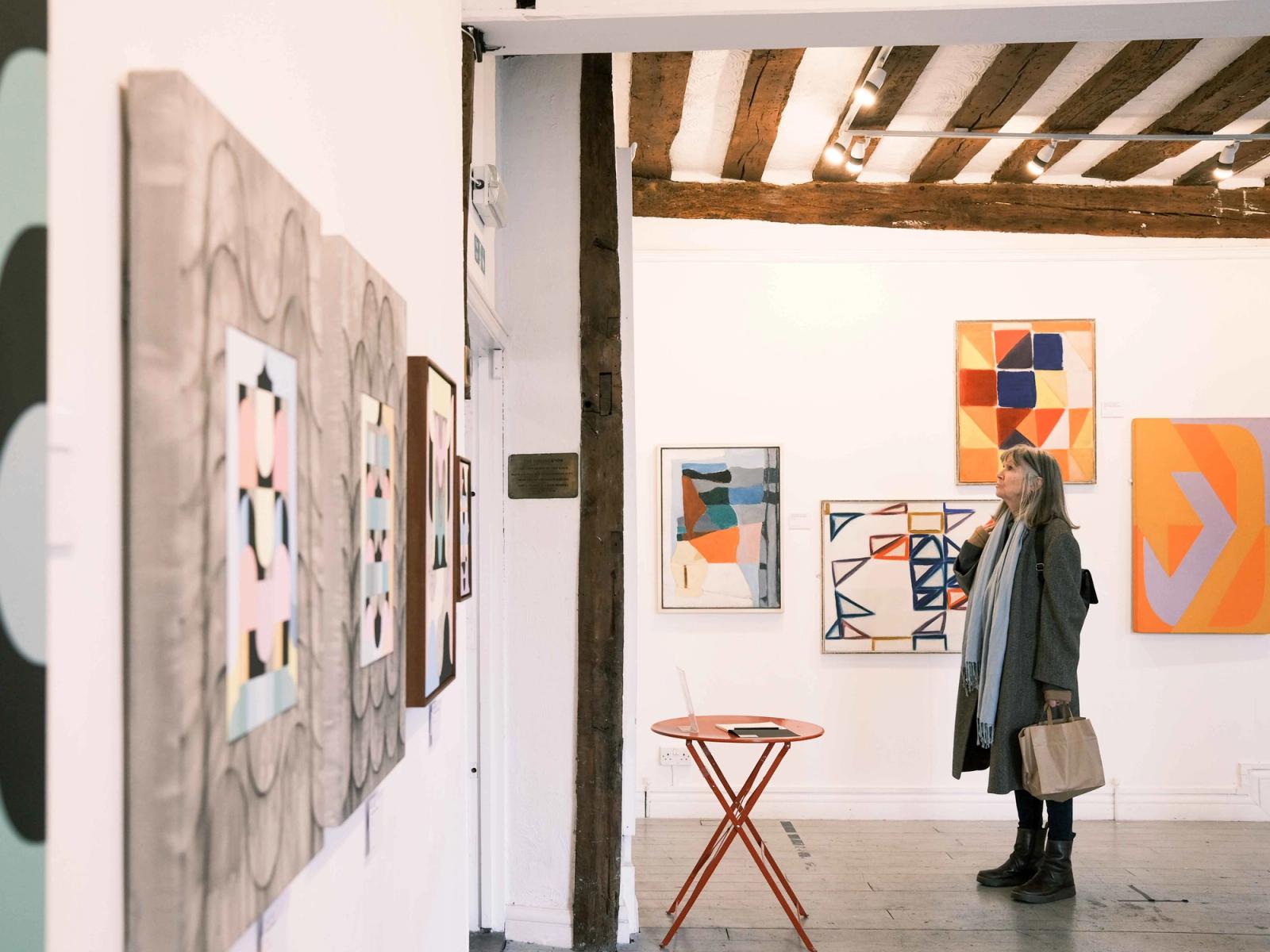
This exhibition celebrates the legacy of modernism in East Anglia through a curated selection of contemporary artists working in abstraction, with work from three key phases of legendary abstract artist Margaret Mellis’ career as starting points. The earliest artwork by Mellis on display is an interpretation of a still life created in the 1950s, then during the 1960s and 70s she created a series of large paintings featuring abstract shapes, known as ‘colour structures’. In 1978, after her move to Suffolk, she started creating driftwood reliefs from wood collected while walking along the local coast at Southwold.In addition to Mellis’s work, the exhibition features a variety of artists who interpret abstraction in compelling ways. utilises loose, painterly techniques while’s careful compositions focus on flat colour planes and reflections. and enrich the exhibition with their innovative use of wood and found objects, mirroring Mellis’ practice during her time later in life living in Suffolk. and interpret the world around them in contrasting ways, Ansell’s work is a sweeping exploration of natural forms and colour, whereas Philo’s work incorporates tessellation - mirroring shapes and patterns seen in contemporary and historical architecture. ’s paintings respond to the unique landscape of post-war Britain, whereass sculptures respond the the inner world of thought and emotion.Abstraction across a plethora of media is on display - the soft nature of thread is challenged by the tight lines of ’s textile pieces, and ’ reclaimed scrap metal assemblages are a delicate balance of disperate shapes coming together to form a whole.Abstract artists often explore the relationship between two and three dimensions. ’ sharp forms draw connections between abstraction and architecture, and Molly Thomson’s jutting shapes are a bridge between wall and space. ’s 3D sculptures reimagine the boundaries of drawing and space, inviting viewers to consider the dimensionality of abstraction in new ways, whilst ’ kinetic works add an element of movement.Together, these artists reflect the enduring impact of modernism and its evolution in contemporary art. Through their diverse interpretations of abstraction, they continue to draw inspiration from Mellis’ pioneering spirit, demonstrating a vibrant dialogue between past and present.